The Enduring Appeal of Characters
in the work of William Faulkner
One critic wrote of the novelist Charles Dickens, a summation equally true of WilliamFaulkner, “his books are verminous with characters.” Of the hundreds of Faulkner characters, many appear, again, and again in his stories and novels, although some central characters, Joe Christmas and Dilsey (with only one minor mention), appear in only one work. Of the recurring characters, some recur in minor roles such as Tull, Quick and Bookwright, who form a sort of male chorus, which reappears when Frenchman’s Bend becomes the setting for a scene.
However, Quentin Compson and Gavin Stevens act as major characters in multiple works. One cannot imagine The Sound and the Fury, and Absalom, Absalom! without Quentin. While Gavin Stevens, the subject of my thesis at the University of Mississippi, is actually the character who recurs most often in Faulkner’s works in a major role. He appears as a major character In
Knight’s Gambit, Intruder in the Dust, Requiem for a Nun, The Town, and The Mansion, besides appearances in several minor works.
Recurring characters are a common convention in situation comedy, or simple historical fiction, but Faulkner’s work is neither, though he does dip into rustic humor based on known characters. Nor is such recurrence accidental. Faulkner is not a careless writer, but a meticulous one. His carefully crafted genealogies of his characters and of the history of Yoknapatawpha County demonstrate intentionality. Therefore, these recurrences must be not just convenient nor unintentional. Quite the contrary; they are a deliberate choice in his art.
His author’s note prefacing the The Mansion not only acknowledges that Faulkner was deeply concerned with accurate timelines for his characters’ lives and behavior, but also may reveal a reason behind his concern:
This book is the final chapter of, and the summation of, a work conceived and begun in 1925. Since the author likes to believe, hopes that his entire life’s work is a part of living literature, and since “living” is motion, and “motion” is change and alteration and therefore the only alternative to motion is un-motion, stasis, death, there will be found discrepancies and contradictions in the thirty-four year progress of this particular chronicle; the purpose of this note is simply to notify the reader that the author has already found more discrepancies and contractions than he hopes the reader will–contradictions and discrepancies due to the fact that the author has learned, he believes, more about the human heart and its dilemma than he knew thirty-four years ago; and is sure that, having lived with them that long time, he knows the characters in this chronicle better than he did then.
—W.F.
He says “lived with”; not “written about”; not “invented”; not “imagined,” but “lived with.” He has known these characters for thirty-eight years, which would translate into his entire writing life, from the year 1925 when he wrote his first novel, Soldier’s Pay to when he wrote these words in 1959. “And I have learned them better. “ He writes it just as I might say, “I have gotten to know Dr. Quinn Peeper (Chairman, Faulkner Society and English Speaking Union Society) better in these ten years I have known him.”The assumption of Faulkner’s statement here is that these characters are real, living people to him and always have been real for thirty-eight years. He has dwelt with them, laughed at them, pondered their lives, their motives, their interests, their obsessions from the beginning of his writing career and what has changed is not their existence, but simply an increase in his understanding of them as independent beings. (I do not in the least mean that Faulkner was deceived; his self-assumed title of “William Faulkner High Sheriff and Sole Proprietor” on his hand-drawn map of Yoknapatawpha County makes clear that he is in charge.) However, since they have been living people to him for his entire career, they can change and, indeed, should change with time. They are growing, changing, living beings, just as Faulkner himself was a living being and coul grow in his understanding of his characters’ motivations, feelings, problems. He clearly wishes the reader to be in no doubt that he has made arbitrary changes or discrepancies, but simply to see these contradictions as a result of living growth.
Without any doubt, Faulkner’s belief in living reality of his characters is one he wishes his readers to share. Creating such an illusion of realism in his readers created a challenge for Faulkner since characters include gangsters, rapists, cheaters, sexual predators, drunkards, suicides, murderers, bootleggers, and multiple obsessed fanatics. But instead of such characters remaining simple grotesques, Faulkner humanized them by situating them in history.
Faulkner’s view of history encompasses not just a character’s personal history, but his community’s history, his family’s history and even national history itself. One might say murderers and rapists have families and backgrounds, too. They can be living beings whom we can begin to understand. The perfect example is, of course, Mink Snopes, a vicious killer, a “little rattlesnake,” but true to his misbegotten obsession.
Faulkner’s aim is to create a shared belief in the reader in the reality of the characters. That goal explains his meticulous historical time-lines and genealogies. He roots his characters in personal and communal history. He works out the genealogy for the Compson family for eight generations; the McCaslin family, with its incestuous complexity, for five generations; the
Stevens family for four generations, and the Sartoris family for six generations. Indeed, he demonstrates the inhuman danger of the sinister Snopes family by the fact that no one is able to determine their family tree. Is old Ab an uncle or a father or a cousin? How is each Snopes related to another? No one in the Yoknapatawpha world knows. And instructively, their unions, when they occur, seem largely to be sterile, including, by the way, Linda Snopes. The only Snopes to produce named children is the only one Ratliff and Gavin feel escapes Snopesism: Wallstreet Panic, whom they conclude is not a real Snopes.
Therefore, carefully worked-out genealogies and time-lines bear evidence that rarely does anything happen in Faulkner’s writing because of his carelessness. The uniqueness of Faulkner’s habitual genealogical pattern becomes more clear if we contrast Faulkner with other great figures in American literature with which he was familiar. Hawthorne, for instance, gives almost no background on Hester Prynne in one or two sentences with a vague reference to her ancestral home. Melville gives no background about his Ishmael, which omission seems to be
an evident part of the famous opening line: “Call me Ishmael.” And Huckleberry Finn has no family except a useless, vindictive and drunken father. His background is completely unknown .Faulkner, by contrast, in Light in August, gives detailed genealogical family history for Joanna Burden and for Hightower besides his two generational history for Joe Christmas. Even Linda Snopes’ last act in Jefferson is to find and give the Snopes mansion back to the last two old ladies who are heirs of Major de Spain.
All of this added history, the many repetitions of the names of the first families of Jefferson—Sartoris, Ratcliffe, Habersham, Compson, Grenier—which Faulkner repeats again and again in his works like a litany, are intended to root his characters and their world not in fantasy nor in a Southern Gothic nightmare, but in reality.
That reality is heightened, intensified, but rescued by being grounded in personal and community history in real factual time. While within that reality, strange things happen, strange tales are told, and obsessions stalk the land.
—Robin Sinclair.
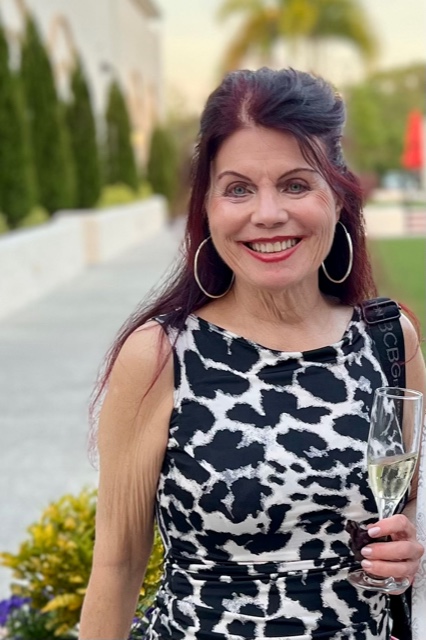
Susan “Robin” D. Sinclair, B.A., M.A., M.L.A.S., Ph.D., a Nashville, TN native, received her B.A. summa cum laude with majors in English and American literature and theology and attended summer studies in English at Jesus College, Oxford in England. Recipient of a Fellowship from the University of Mississippi, she and studied and taught Southern literature with an emphasis on William Faulkner and served as a guide at Rowan Oak, Faulkner’s home in Oxford, MS. The thesis for her Master of Arts degree from University of Mississippi was Gavin Stevens: Faulkner’s Romantic Hero. She received her Ph.D. from Duke University with studies in Shakespeare, English Romantics and American Literature and did post-doctoral research at Yale University in Faulkner Studies. She also holds a Master of Liberal Arts and Sciences degree and a certificate in Fine Arts, from Vanderbilt University. An appraiser of 18th and 19th century decorative arts, her firm is Sinclair Appraising and Consulting. She is a member of the English Speaking Union and has served on its National Board of Directors.